
Beauregard Parish Criminal Court Records
A Beauregard Parish criminal court record is the case file kept by the Clerk of Court once a criminal matter is filed in the 36th Judicial District Court. The Clerk's Criminal Department opens and indexes new criminal cases, processes pleadings, files documents, keeps criminal minutes, receives exhibits and evidence, administers oaths, and handles copies and certifications. That file can show the charges filed in court, the plea, motion practice, hearing history, disposition, and sentence. It is the court's record of prosecution, not just a law-enforcement booking event.
The 36th Judicial District Court is the parish's general jurisdiction trial court. It has original jurisdiction over civil and criminal matters in Beauregard Parish. Division A is Chief Judge Martha Ann O'Neal, and Division B is Judge C. Kerry Anderson. Research from the local rules appendix says the divisions do not have exclusive subject-matter jurisdiction and that the judges rotate monthly between civil and criminal dockets. Limited local courts may handle municipal or traffic matters, but felony and other district-court criminal case files are tied to the 36th JDC and the Clerk's criminal records work.
The Clerk Criminal Department page is the core local source for criminal court record duties.
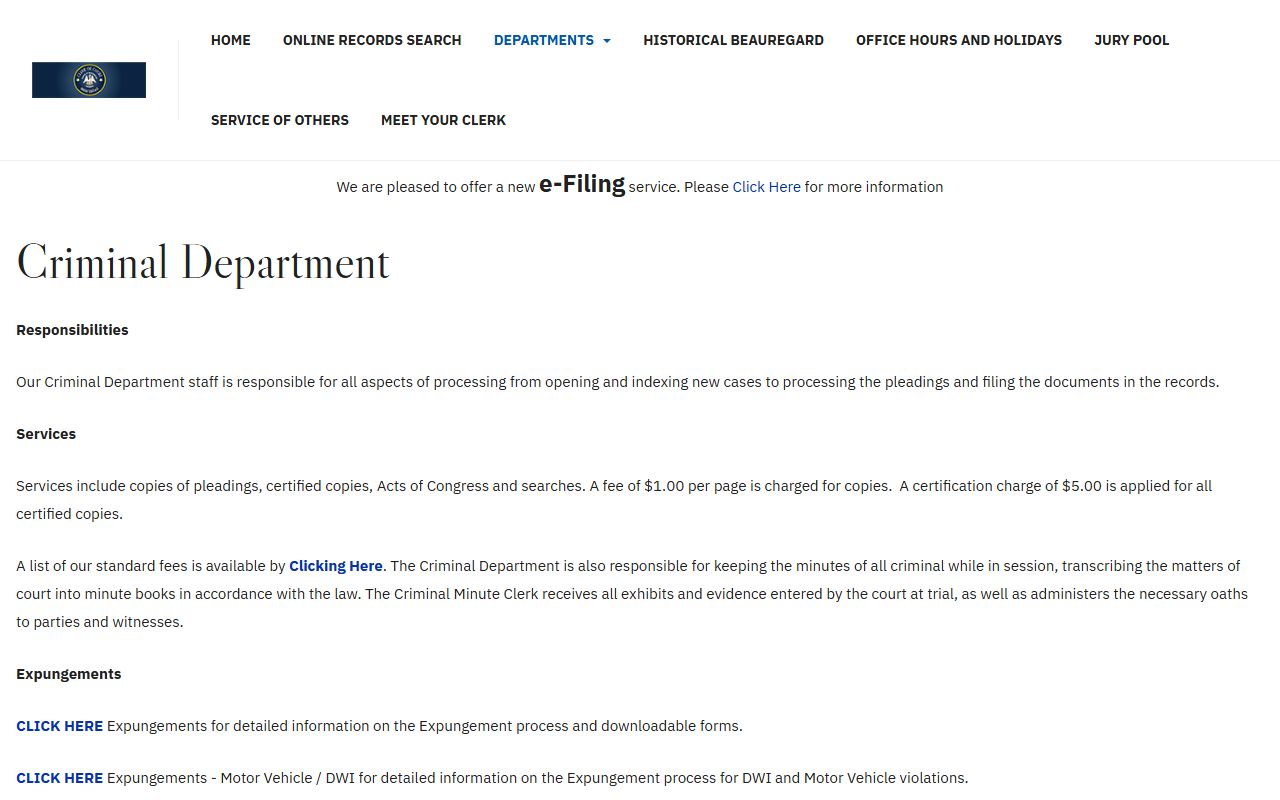
The department page anchors criminal case lookup in Clerk functions rather than in jail roster or arrest-only records.
Search Beauregard Parish Criminal Court Records
Criminal case searching begins with the Clerk online records page, which routes civil and criminal case searches to ClerkConnect. The public research found that ClerkConnect is subscription based and does not expose Beauregard-specific search fields before login. A public user should not assume that a missing search result means no case exists. Older records, unreleased records, restricted records, and records not yet indexed may require direct Clerk contact. For all court records beyond criminal cases, the broader Beauregard Parish court records page explains the COTT and ClerkConnect split.
- Confirm that the record is a criminal court case rather than a jail booking, traffic payment, warrant tip, or federal prosecution.
- Open the Clerk online records route and use ClerkConnect for civil or criminal case access.
- Search with the defendant name or case number if the portal account allows those fields.
- Review any docket or minute entries for charges filed in court, hearing events, disposition, and sentence.
- Request plain or certified copies from the Clerk's Criminal Department when a portal printout is not enough.
State or federal criminal history channels are separate. The research file did not identify a free Louisiana statewide public case-search portal for Beauregard criminal cases. Federal criminal cases from Beauregard Parish go through the Western District of Louisiana and PACER, not the parish Clerk. Jail custody questions go to the Sheriff roster or jail phone. A jail profile can list charges and booking data, but it is not the complete criminal court file and may change after court appearances.
Beauregard Parish Criminal Case Flow
A criminal court record changes as the case moves through court. The District Attorney decides how to prosecute after an arrest or summons, files a bill of information or presents a matter for indictment where applicable, and handles pleas, victim issues, sentencing positions, and post-conviction responses. The Clerk then opens and indexes the criminal case and records the court activity. Charge details can be read with more care on the Beauregard Parish arrest records and court charges page, while the criminal case file remains the main record for outcome and sentence.
Case flow: Charges Filed › Arraignment › Pretrial / Motions › Plea or Trial › Disposition › Sentencing
| Stage | What Happens |
|---|---|
| Charges filed | The District Attorney files a charging document or the case proceeds from indictment where applicable. |
| Arraignment | The defendant is called to answer the charge and a plea is entered. |
| Pretrial / motions | Parties file motions, request rulings, handle discovery issues, or seek continuances. |
| Plea or trial | The case may resolve by plea or proceed to a trial and verdict. |
| Disposition | The court records conviction, acquittal, dismissal, plea outcome, or other final result. |
| Sentencing | The court enters custody, probation, fine, cost, or other sentence terms after conviction. |
What Beauregard Parish Criminal Records Show
The criminal case file may contain more than the charge name. Research from the Clerk and court-record inventory identifies case number, court and division, filing date, State and defendant, attorneys, pleadings, motions, minute entries, exhibits admitted at trial, hearing dates, disposition, sentence, probation, bond-related financial data, court costs, fines, and copy or certification records. Some information may be visible only as a docket or index. Full documents and images may require subscription access, copy fees, or an office request.
| Field | What It Shows |
|---|---|
| Case number | The Clerk-indexed criminal case identifier. |
| Defendant | The person charged in the court case, distinct from a jail roster booking entry. |
| Charges | The criminal charges filed in court, which may differ from arrest or booking labels. |
| Arraignment and plea | The hearing where charges are answered and the plea entered. |
| Motions and hearings | Requests, arguments, settings, continuances, and court rulings before outcome. |
| Disposition | Dismissal, conviction, acquittal, plea outcome, or other result. |
| Sentence | Custody, probation, fines, costs, or other punishment after conviction. |
| Restrictions | Juvenile, sealed, expunged, and confidential data that may be blocked or redacted. |
Beauregard Parish Charges vs Convictions
A charge is an accusation filed or carried in a case. A conviction is a finding of guilt by plea or trial. The difference matters in Beauregard Parish criminal court records because a case file can show charges that were amended, reduced, dismissed, dropped, or ended in acquittal. The court file is the better place to confirm final outcome because booking charges and roster data can change after court appearances. The Sheriff roster itself warns that charges and bail amounts may not be current and tells people posting bail to call jail staff for correct charges, bail, and case numbers.
| Point | Charge | Conviction |
|---|---|---|
| Meaning | An allegation filed or listed in the criminal process. | A guilt finding by plea or trial. |
| Record location | May appear in arrest, booking, docket, and case records. | Appears in court disposition and sentencing records. |
| Can change | May be amended, reduced, dismissed, or dropped. | May later be appealed, set aside, expunged, or otherwise affected by law. |
| Best confirmation | Review the filed case and current docket. | Review final disposition and sentence through the Clerk. |
The Clerk expungement instructions show how post-disposition relief can affect public access to criminal court records.
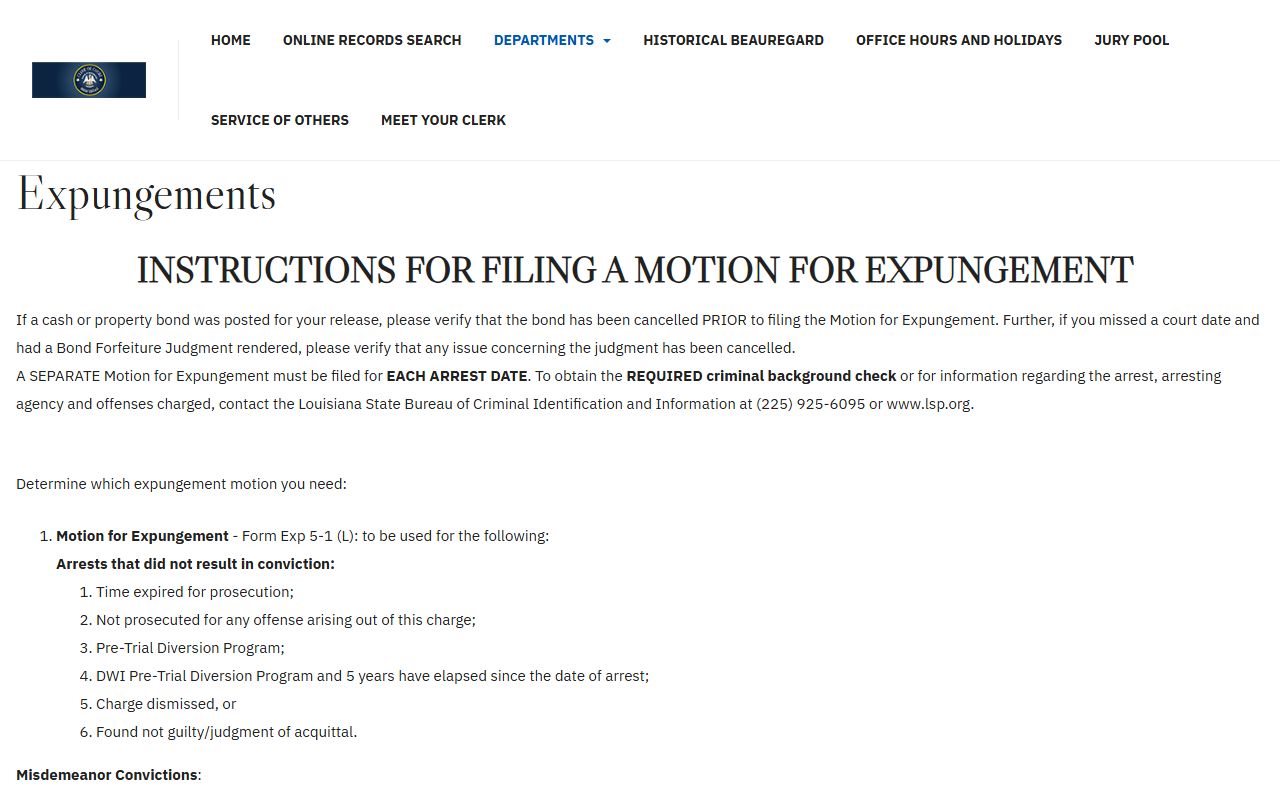
Expungement does not rewrite the original case history for every agency, but it can remove records from ordinary public access.
Read Criminal Dispositions and Sentences
Disposition is the outcome of a charge or case. In a Beauregard Parish criminal court record, disposition language may reflect a guilty plea, not guilty finding, dismissal, acquittal, sentence, probation, or other court action. A sentence is the punishment imposed after conviction. It may include custody, probation, fines, costs, or other terms. The Clerk's record can also include criminal minutes and exhibits admitted at trial. For a certified disposition, use the Clerk's copy process rather than a screenshot or third-party summary.
Financial details can appear in more than one official channel. The Sheriff Civil and Tax Division collects criminal fines, bonds, and traffic fines, while the Clerk handles criminal copies and certification. Criminal copies are listed at $1 per page and certification at $5. If a record is needed for court, licensing, immigration, expungement, or another formal purpose, ask the Clerk which copy type is accepted before paying for a printout.
Note: A docket line may show the outcome, but a certified disposition comes from the Clerk's official record process.
Sealed vs Expunged Criminal Records
Louisiana treats expungement as removal from public access, not physical destruction. Code of Criminal Procedure article 972 defines expungement in that way. Article 971 explains that expunged records remain accessible to law enforcement and other agencies listed by law. A sealed record is also unavailable to the general public, but access depends on the sealing order and court authority. Both categories can make an ordinary Beauregard Parish criminal court record search look incomplete.
| Point | Sealed | Expunged |
|---|---|---|
| Public visibility | Hidden from general public access by court restriction. | Removed from public access under Louisiana expungement law. |
| Record destruction | Not necessarily destroyed. | Not physically destroyed under Louisiana article 972. |
| Agency access | Depends on order and law. | Still available to law enforcement and listed agencies under article 971. |
| How to pursue | Use the court-authorized access or sealing process. | Use Clerk expungement forms and fee rules for the eligible arrest date. |
The Clerk expungement FAQ states the key local point that expungement removes public access but does not destroy the record.
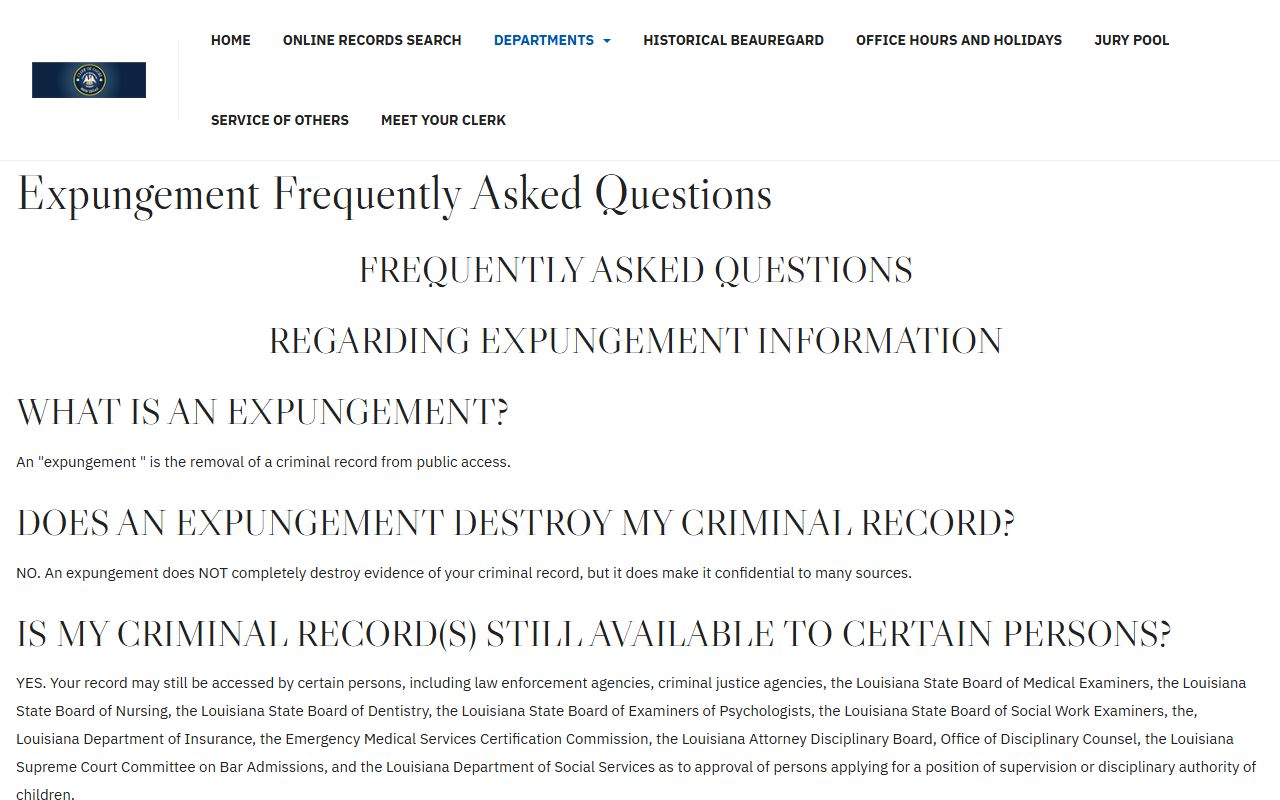
The FAQ is useful when a criminal case once appeared in public access but later no longer appears through normal lookup.
Public Access to Beauregard Parish Criminal Records
Criminal court records are public in many situations, but access is not unlimited. Louisiana R.S. 44:32 gives adults inspection and copy rights during regular office hours and allows reasonable copy fees. For criminal records, Louisiana R.S. 13:5992 also matters because it requires district clerks responsible for criminal records to provide public electronic access to minute entries or summaries for qualifying cases filed on or after January 1, 2020, through the Louisiana Clerks' Remote Access Authority. The research notes that this law does not require full document images and excludes traffic violations.
Other statutes limit publication or access. Children's Code article 412 generally protects juvenile records. Louisiana R.S. 14:133.7 restricts publication of confidential juvenile record information and expunged or nondisclosed criminal-history information, and it requires published criminal-history information to be complete and accurate. This matters for Beauregard Parish criminal records because a partial search result can omit sealed, expunged, juvenile, or nonpublic data.
Louisiana Code of Criminal Procedure article 971 explains expungement effects and access limits.
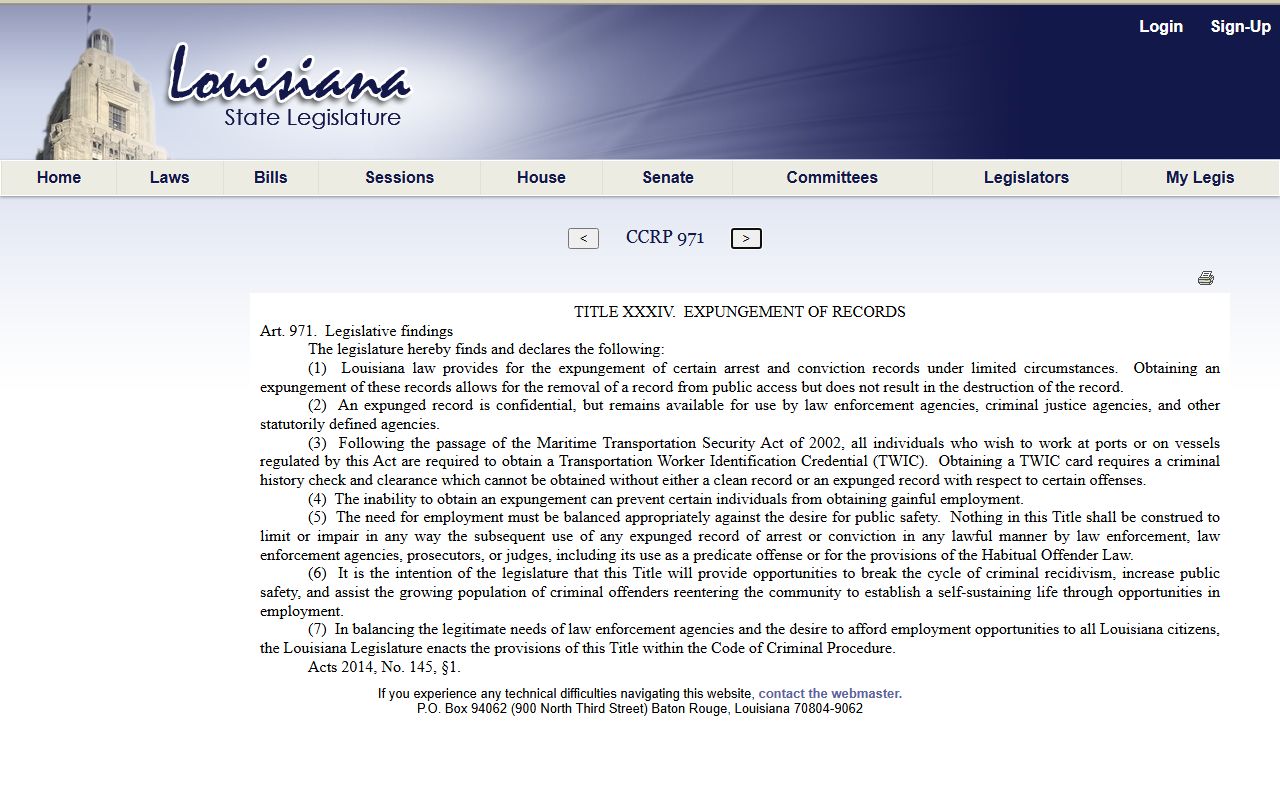
Article 971 is the reason an expunged Beauregard Parish criminal record can be closed to the public yet still available to listed agencies.
Restricted Beauregard Parish Criminal Records
Restricted criminal court records include juvenile material, sealed cases, expunged records, confidential personal identifiers, and some active or sensitive information. The Clerk expungement page gives a detailed local process. A separate Motion for Expungement must be filed for each arrest date. The applicant should verify bond cancellation and resolve bond-forfeiture judgment issues when applicable. The Clerk directs users to the Louisiana State Bureau of Criminal Identification and Information for arrest information and a required criminal background check. The Clerk also names Motion for Expungement Form Exp 5-1(L) and Motion for Interim Expungement Form Exp 9-1(L).
The fee structure in the research is specific: four separate U.S. Post Office money orders unless there is a District Attorney fee waiver certification. The listed payments are $250 to the Bureau of Criminal Identification, $50 to the Beauregard Parish District Attorney, $50 to the Beauregard Parish Sheriff, and $200 to the Beauregard Parish Clerk of Court. DWI convictions require an added $50 money order to the Office of Motor Vehicles. The Clerk says completion can take six months and that certified copies are sent after completion or denial. The Clerk cannot provide legal advice or fill out forms.
Louisiana Code of Criminal Procedure article 972 defines expungement as removal from public access, not destruction.
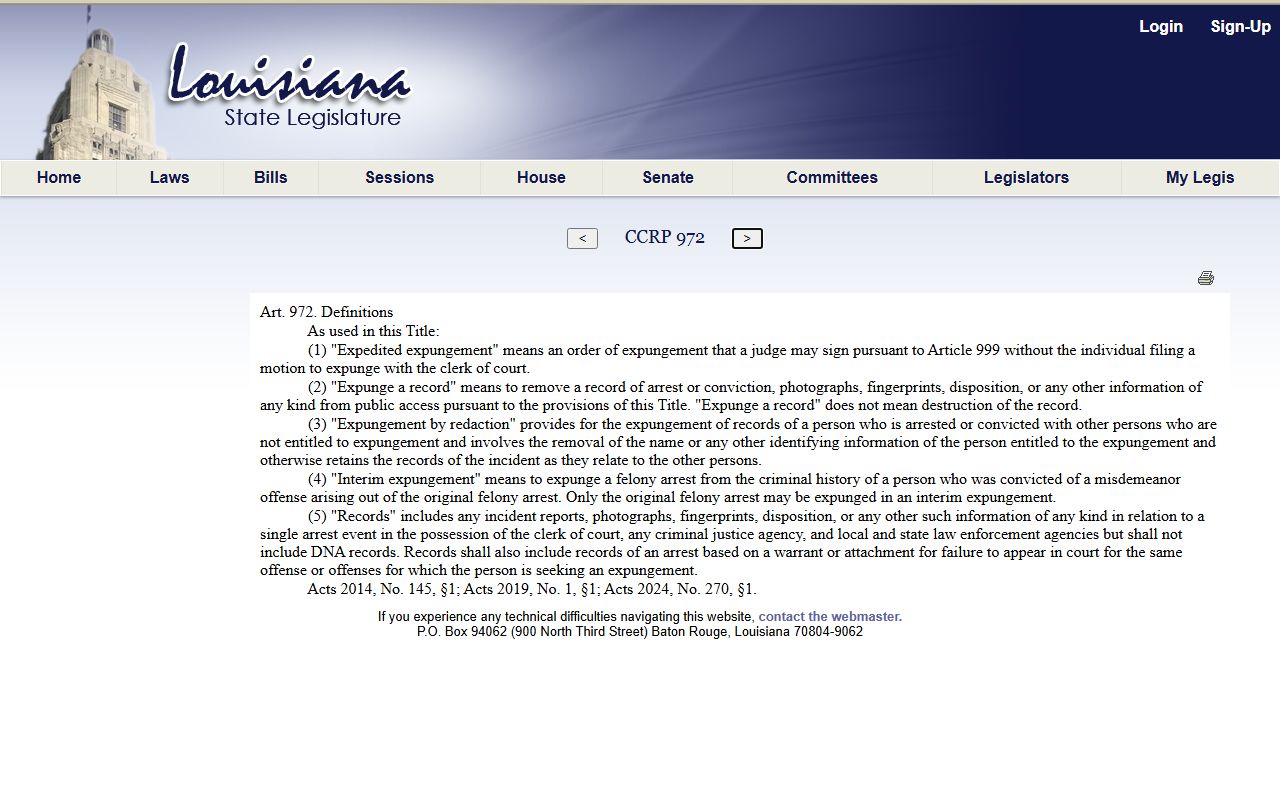
This definition supports careful wording when a Beauregard Parish criminal case is restricted but not erased.
Beauregard Parish Criminal Records Contacts
The Clerk of Court is the main contact for criminal court copies, certifications, and case-file access. The office lists 200 West Second Street, DeRidder, Louisiana 70634, mailing address P.O. Box 100, DeRidder, Louisiana 70634, phone 337-463-8595, civil fax 337-462-3916, and criminal-records fax 337-202-7834. The District Attorney for the 36th Judicial District is James R. Lestage, and the Louisiana DOC parish page lists the District Attorney phone as 337-463-5578. Public defense is handled by Louisiana Office of the State Public Defender District 36, with District Defender Tony C. Tillman, phone 337-462-8891.
Beauregard Parish Clerk of Court
200 West Second Street
DeRidder, LA 70634
337-463-8595
Criminal-records fax: 337-202-7834
Louisiana R.S. 14:133.7 restricts publication of confidential juvenile or expunged criminal-history information.
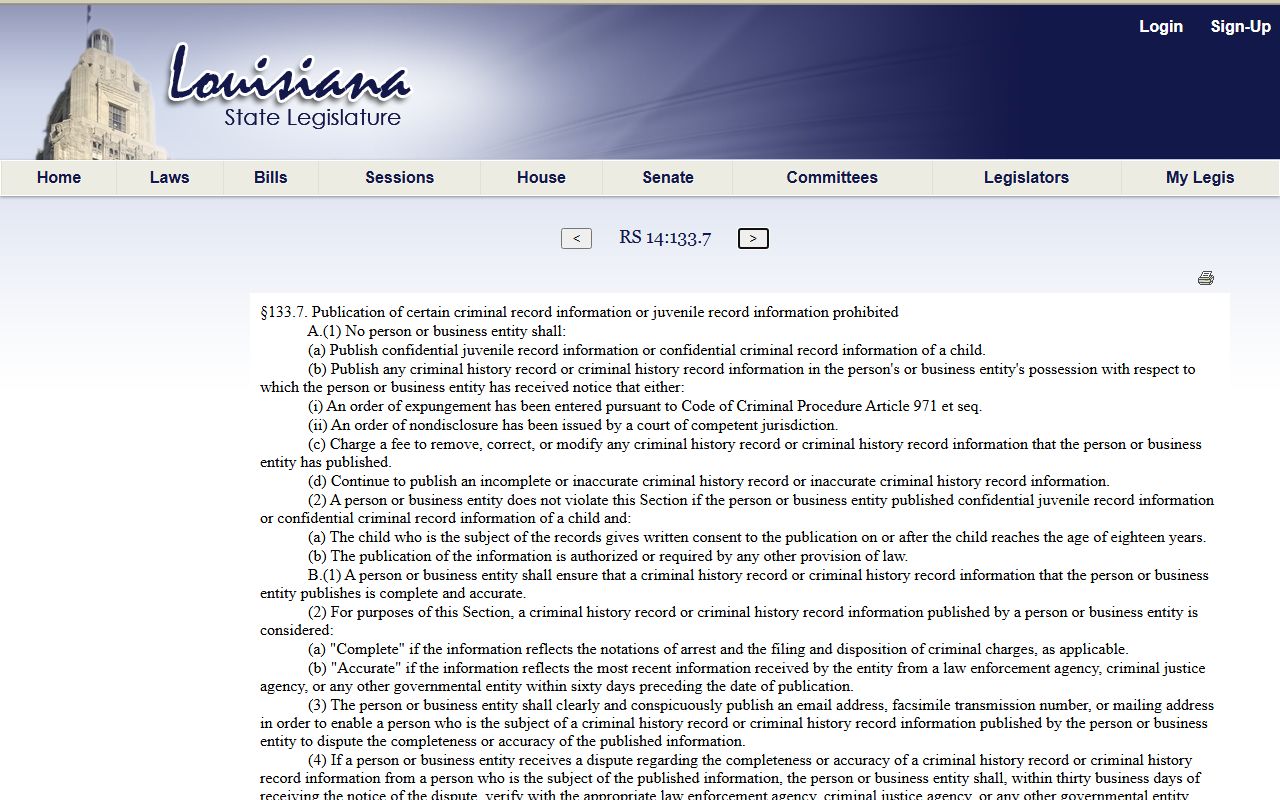
The statute is a reminder that criminal record lookup should distinguish public case facts from protected juvenile or expunged material.